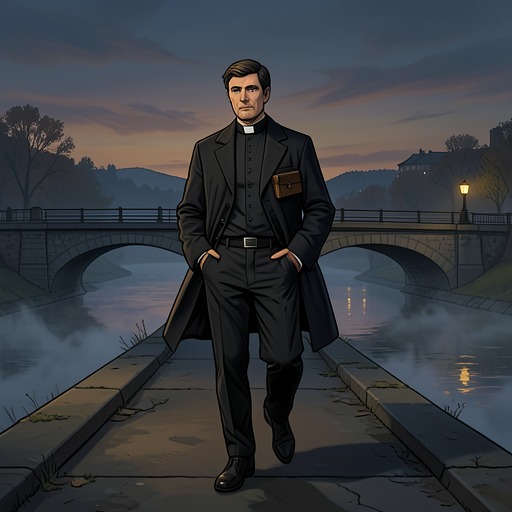
John Hume
Say NothingJohn Hume was a Derry politician and leader of the Social Democratic and Labour Party whose significance in the book rests on his effort to make dialogue possible across a violent political divide. A hero to moderate Catholics, he repeatedly condemned the Irish Republican Army’s campaign and rejected contact with Sinn Féin while that violence continued. Yet he was willing to speak with anyone if the purpose was peace. His secret meetings with Gerry Adams, and the careful exchange of documents that followed, turned that difficult distinction into a political opening.
Identity and Political Position
Hume stood within a society shaped by partition and unequal power. Catholics in Northern Ireland faced discrimination in housing and employment and lacked access to the political authority that might change their conditions; for half a century, no Catholic had held executive office. Against that background, Hume became a prominent voice for moderate Catholic nationalism. His political position did not amount to acceptance of the Irish Republican Army’s armed campaign: he treated the movement’s violence as an obstacle to peace and challenged the contradiction between its military and political wings.
Condemnation and the Cost of Opposition
Hume’s criticism was concrete and public. In 1985, he condemned attacks on factories and workers, on teachers and school bus drivers, and on people in hospitals and on campuses. He also challenged the republican movement’s claim to speak for the poor while its attacks and robberies harmed ordinary people. To him, the combination of armed violence and political organizing looked calculated: the military wing could deepen deprivation, while the political wing sought support by drawing upon the resulting discontent. He warned that Sinn Féin risked being consumed by that contradiction.
Opposition to the Irish Republican Army carried personal danger. Several months before the 1987 bombing at Enniskillen, the organization firebombed Hume’s home. He was away, but his wife and youngest daughter were inside and only narrowly escaped. In autumn 1987, the Irish Republican Army detonated a bomb at an Enniskillen Remembrance Day commemoration, killing ten civilians and one British soldier and wounding more than sixty people. The organization said the attack was a mistake and that British soldiers at a nearby ceremony had been its intended target. Gerry Adams apologized and distanced himself from the bombing, but Hume condemned it as an act of savagery. The attack further isolated the Irish Republican Army and underscored how politically hazardous it was for Hume to pursue contact with its leadership.
Father Reid’s Proposal and Secret Dialogue
Hume’s opposition to violence did not mean that he ruled out negotiation. He had said he would talk with anyone if the objective was peace, although he publicly refused dialogue with Sinn Féin for as long as the Irish Republican Army’s campaign continued. Father Alec Reid, who had built trust in the republican community through years of quiet work, believed that the organization could be persuaded to end its campaign if the situation was handled properly. Six months after Hume’s denunciation of the republican strategy, Reid wrote to him, explaining that his aim was to help prevent further deaths and arguing that he could use his standing with the Irish Republican Army to encourage an end to the violence.
On 11 January 1988, Hume met Gerry Adams at Clonard Monastery. The men had spoken secretly before; the account identifies 1986 as the date of their first meeting. Their contact was dangerous on both sides. Hume risked the political cost of appearing to engage with a movement whose violence he had condemned. Adams, a strategist rather than an operational figure, risked being regarded within the Irish Republican Army as someone who had compromised the armed struggle; in 1988, such a suspicion could be lethal. Their meeting nevertheless began constructively. Hume found Adams more personable and straightforward than the frightening image he had expected, and saw a politician with whom it might be possible to work.
They agreed to exchange documents setting out their organizations’ positions and establishing the parameters for a possible peace agreement. The transfer depended on secrecy and small acts of practical care. At a funeral Mass for Kevin Brady, Father Reid received a brown envelope containing a Sinn Féin position paper. He carried it when he left the church and later ministered to two murdered British corporals; blood from that encounter smudged the envelope. Back at Clonard Monastery, Reid moved the papers into a clean envelope and took them personally to Hume in Derry. The stained document, transferred and recopied, made the risks surrounding this early channel visible in material form.
Public Hope and Political Change
By November 1995, the book presents Hume as a public advocate of a future beyond killing and emigration. In Derry, he introduced United States President Bill Clinton before Clinton spoke outside the Guildhall, beneath Christmas lights. Hume described Clinton’s hope for a coming century in which there would be no killings in the streets and young people would no longer have to leave for other lands. The setting gave that appeal particular force: Clinton remarked that the city had changed since the ceasefire, with soldiers gone from its streets and the city walls open to civilians.
Hume’s political role is therefore not presented as a simple conversion from confrontation to agreement. He maintained a sharp public challenge to the Irish Republican Army’s violence, even as he accepted the personal and political risks of confidential contact. Father Reid’s mediation enabled adversaries to exchange positions without first resolving their differences. The route toward peace began not with an erasure of those divisions but with a practical decision to meet, listen, and carry a document across them.